Finding the same ingredient name in a paper and on a product page is the beginning of an evidence check. A scientific claim also depends on the preparation, participants, comparison and measurement. A description of an ordering process answers another kind of question. Both records can be useful, provided their conclusions remain connected to what was actually evaluated rather than borrowing authority from each other.
This article examines how to make those connections responsibly. The Rx Skin Review methodology supplies the publication's broader framework; here the emphasis is on experimental reasoning. Study details are stated compactly, followed by original explanations and explicitly hypothetical examples. None of the examples represents a customer experience, a reconstructed trial result or a claim that a named service has cited these studies.
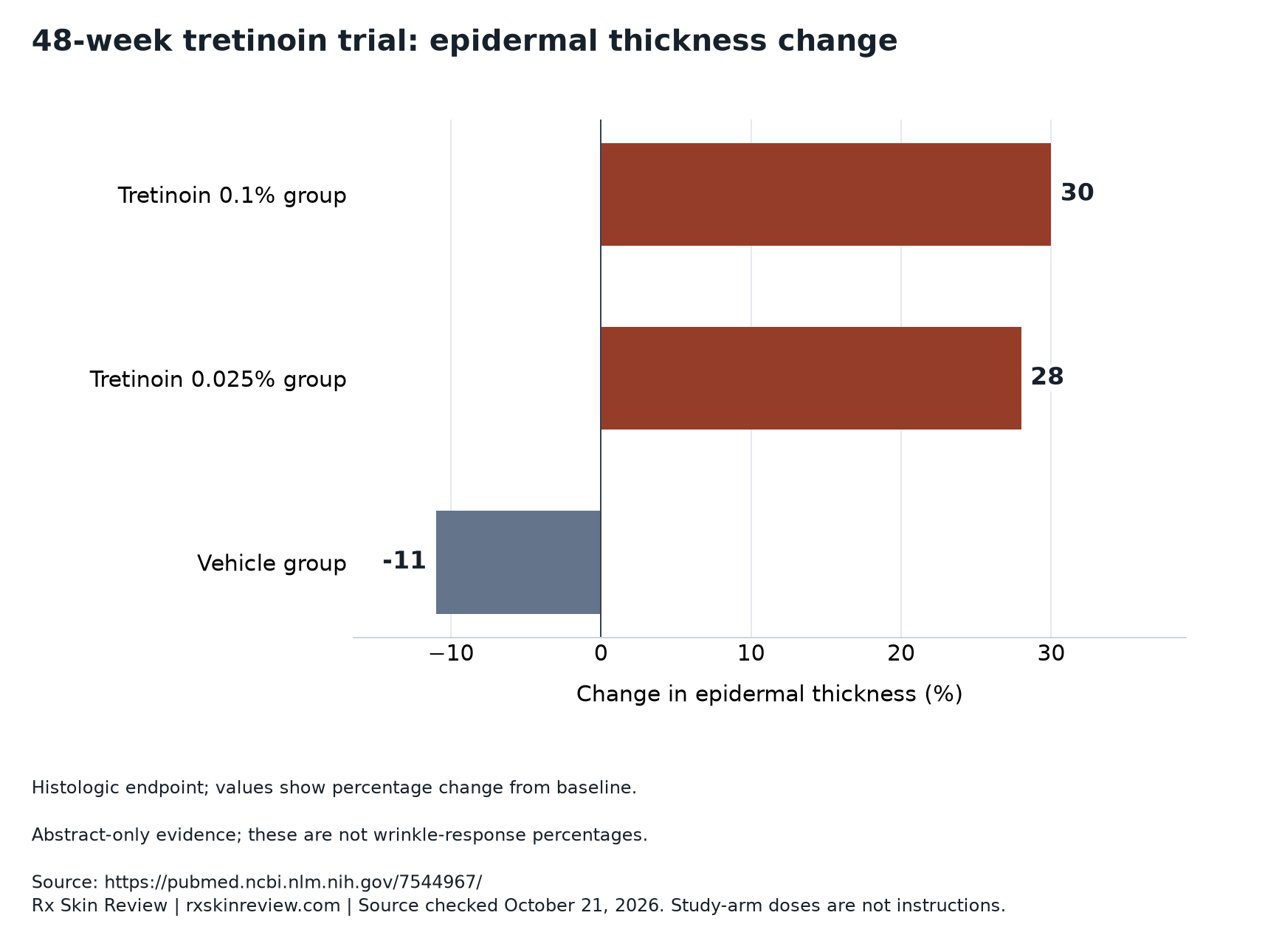
48-week tretinoin trial: epidermal thickness change
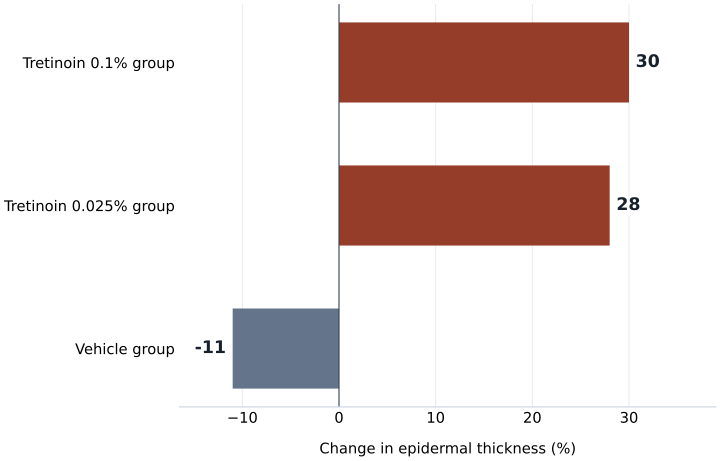
Histologic endpoint; values show percentage change from baseline.
Abstract-only evidence; these are not wrinkle-response percentages.
Download the source-labeled chart (PNG) · Download the data (CSV) · Download the chart (SVG)
| Study group | Reported value |
|---|---|
| Tretinoin 0.1% group | 30 |
| Tretinoin 0.025% group | 28 |
| Vehicle group | -11 |
Sections in this article
Begin with the treatment comparison
The indexed 1995 abstract reports a double-blind comparison completed by 99 people with facial photoaging after 48 weeks: 0.1% tretinoin cream (32), 0.025% (35), and vehicle (32). Both active creams improved clinical appearance versus vehicle, without clinically or statistically significant efficacy separation. Higher strength produced more erythema and scaling. Epidermal thickness and vascularity were tissue outcomes. Initial enrollment, allocation method, attrition, clinical effect magnitudes, confidence intervals and funding are unreported in that abstract.
An experiment is organized around a defined contrast: what differs between the interventions and what is measured afterward. A treatment comparison might estimate an appearance outcome under specified conditions. To investigate how an ordering service performs, researchers would instead define service outcomes and collect observations capable of answering that question. The scientific task changes when the claim changes.
This distinction does not make a practical service question unimportant. It prevents an answer to one question from masquerading as an answer to another. A reader can ask whether a treatment has relevant clinical evidence while separately investigating whether a service's documented terms meet their needs. Combining those judgments requires keeping their inputs visible, rather than assuming that a research citation establishes the quality of every surrounding commercial process.
Understand what the comparator contributes
A before-and-after observation follows a person through time. A controlled comparison additionally asks how an alternative condition behaves during the same period. That extra information matters because changes can accompany observation, accompanying care, natural variation or measurement practices. The contrast is intended to help distinguish a treatment contribution from changes that are not specific to the treatment being evaluated.
The invented example below uses the same starting severity and observation time for two groups. Both improve, but their changes differ. The treatment group's total change is therefore not identical to its advantage over the comparator. These calculations demonstrate the distinction only; they do not estimate an effect for any medication. The fine-lines reference identifies a concern, whereas a causal claim requires this additional definition of comparison.
Even a numerical contrast needs a credible design. If groups differ in other important ways, those differences could contribute to the result. Random assignment, when actually performed, aims to reduce systematic allocation differences; standardized assessment aims to reduce measurement differences. Neither feature is established by a favorable-looking photograph. A persuasive interpretation connects the calculation to the procedures that make it meaningful, including how participants entered the analysis and how outcomes were obtained.
| Invented comparison | Baseline → week-12 score | Change in score points |
|---|---|---|
| Treatment group | 8 → 5 | −3 points |
| Comparator group | 8 → 6 | −2 points |
| Treatment change minus comparator change | Comparison of the two changes | −1 point; this differs from the treatment group's total change |
Keep the measurement attached to the promise
A claim about an appearance rating needs an appearance rating. A claim about a microscopic feature needs a measurement of that feature. A claim about satisfaction needs a defined satisfaction measure. These outcomes can be collected together, but their numbers do not acquire interchangeable meanings merely because they appear on the same page or concern the same preparation.
Suppose, as an illustrative exercise, that a measured tissue quantity rises from 20 to 22 units. The relative increase is 10%. That does not create a definition for being 10% younger. Such wording would require an independently specified outcome and a defensible relationship between that outcome and the laboratory measurement. Arithmetic can be correct while the attached verbal claim is scientifically undefined.
Clinical scales require care as well. Categories can order severity without proving that every step represents an equal biological amount. Before converting a score into a percentage, ask whether its properties support that interpretation. The firmness reference is an example of a consumer concern that needs a precise experimental definition before it can become an outcome. Useful evidence identifies what was measured, who measured it, when it was measured and how the score or physical quantity was interpreted.
Give better and equivalent their own tests
Better needs an outcome and a direction: a lower severity score, fewer reactions or another specified advantage. Equivalent needs a justified range of differences small enough to count as clinically unimportant. These claims require different analytical questions. Neither can be supplied by choosing an appealing adjective after seeing the results of a conventional statistical test.
Precision is central to the distinction. Imagine an estimated advantage of 0.2 points on a hypothetical scale. An uncertainty interval from −0.3 to 0.7 leaves a different set of possibilities open than one from −1.8 to 2.2. Both invented intervals include zero, yet the second is much less precise. A statement about statistical significance alone would omit that difference in information.
Clinical importance adds another judgment. A difference might be estimated precisely while remaining too small to matter for the intended outcome; a potentially important difference might remain uncertain. To examine equivalence, researchers must justify the acceptable margin and use an appropriate prespecified analysis. To compare benefit and tolerability, they must define both. A reader gains more from these separate questions than from a single ranking that conceals which advantage, uncertainty or tradeoff produced the ordering.
Distinguish a reaction from a mechanism of benefit
A symptom can be important to a participant without being a reliable indicator of treatment success. To use a reaction as an indicator, investigators would need evidence about how well it predicts the desired outcome, including circumstances in which the two diverge. To claim that it causes the outcome requires a stronger causal argument than prediction alone.
For an original thought experiment, imagine an intervention that changes both a visible symptom and an appearance score. Several explanations remain possible: the symptom lies on the path to improvement, both reflect another treatment effect, or additional influences affect their relationship. Observing two responses does not select among those explanations. Timing, repeated measurements and an analysis of alternative pathways would help make the causal question testable.
Tolerability also needs a collection method. Spontaneous complaints, scheduled questioning, examiner ratings and treatment interruptions may capture different aspects of an experience. Counts of symptom categories are not necessarily counts of unique people, because one person can report several symptoms. Comparing products responsibly therefore requires compatible definitions and follow-up periods. A claim of greater comfort, a claim of fewer affected participants and a claim of fewer treatment interruptions each needs its own clearly specified evidence.
Test the move from an experimental lotion to a wider audience
The full 2007 retinol paper describes 36 adults averaging 87, all white with phototypes I–II, in a randomized comparison of 0.4% lotion and vehicle on opposite sun-protected upper inner arms. Twenty-three completed 24 weeks; all-participant analysis used last observations carried forward. Primary fine-wrinkle changes on a 0–9 scale averaged −1.64 (95% CI −2.06 to −1.22) versus −0.08 (95% CI −0.17 to 0.01), P<.001. Three withdrew because of cutaneous symptoms. Four authors disclosed patent-inventor interests with conditional royalties; no separate funding statement was located.
Applying an experiment to a broader claim is a problem of applicability. A new audience, body site or formulation introduces a question about whether the relevant treatment effect would persist under those conditions. An ingredient's family resemblance to another ingredient is not an experiment that isolates their difference. The companion retinol article develops the separate research question in more detail.
One way to examine a missing-outcome assumption is to construct explicitly illustrative alternatives. Suppose a person has a score of 6 at an interim visit and no later measurement. Using 6 at a later endpoint differs from assuming further improvement to 4 or deterioration to 7. These invented values describe no trial participant. They show why an imputation rule's effect depends on the unobserved trajectory. Sensitivity analysis explores reasonable alternatives instead of confusing analytical inclusion with newly collected data.
Ask which time-related claim a longer study answers
The indexed abstract of a separate randomized trial describes 204 people with moderate to severe facial photodamage treated with 0.05% tretinoin emollient cream or vehicle for up to two years. Clinical comparisons favored tretinoin (P<.05), without numerical effect sizes or confidence intervals. Procollagen-marker expression increased at month 12; specified atypia measures did not increase versus vehicle. Funding is not identified in the abstract.
Time can enter a claim in several ways: speed of first response, improvement during continued treatment, persistence after treatment ends or the appearance of later harms. Answering one does not logically settle the others. A longer observation period is useful only in relation to the measurements and treatment conditions that occupy it. The mature-skin reference groups a broad concern; a time-related research question must be narrower.
For example, a hypothetical study could assess an outcome only at baseline and its final visit. It could document a difference by the final visit without identifying exactly when that difference began. Adding intermediate observations would answer another question, subject to their precision and analysis. Likewise, a biological marker may illuminate a process without establishing prevention of a clinical disease. Matching the time claim and endpoint avoids turning duration alone into a promise of faster results or protection from future events.
Use labeling to identify the product-specific boundary
Current RENOVA labeling, examined in full, concerns 0.02% tretinoin cream as an adjunct for mitigating fine facial wrinkles with comprehensive skin care and sunlight avoidance. It does not claim wrinkle elimination or repair of photodamage. Local irritation, increased sunburn susceptibility and avoidance during pregnancy or attempted pregnancy are relevant warnings. Approximately 4% discontinued the drug because of adverse reactions; daily use beyond 52 weeks lacks established safety and effectiveness.
A label is a different kind of evidence document from a research report. Its claims and instructions belong to a specified product. Matching a product to a paper therefore involves more than spotting a shared active ingredient. The RENOVA review offers a route to its documentary record, while the scientific question remains whether the preparation, population and outcome support the proposed comparison.
This distinction prevents two common substitutions: treating an investigation of one formulation as authorization for another product's claim, and treating a product's indication as a complete account of every related scientific question. A careful comparison preserves both records. It can describe a research finding and a labeled use without assuming that either has changed the scope of the other. Formulation details are part of identifying the intervention, not optional fine print to discard when a more expansive conclusion sounds attractive.
Build a testable claim before selecting its evidence
Consider a hypothetical claim that a product delivers a visible change more quickly. Before searching for a favorable study, define the visible change, how it would be measured, the relevant time window and the competing treatment or condition. The resulting question may require a direct comparison with repeated assessments. A paper about biological activity alone would answer a different question, however persuasive its laboratory measurements appear.
This is the distinction between evidence that supports a mechanism and evidence that estimates a clinical comparison. Mechanistic evidence can motivate an experiment and help interpret its findings. It does not automatically supply the effect size, timing or tolerability of the finished preparation in the intended population. The table gives examples of matching evidence requirements to a proposed claim; it reports no tested commercial promises.
My editorial interpretation is that the same discipline should govern product reviews. A reader consulting the RedBox Rx review can examine documentary terms while keeping a clinical efficacy question separate. The link does not establish a match to an experimental preparation. An organized comparison starts with the claim's definition and then identifies the evidence needed, rather than starting with a citation and expanding the claim until it sounds comprehensive.
| Hypothetical claim | Evidence needed to evaluate it | Important distinction |
|---|---|---|
| A visible outcome improves faster | A defined clinical outcome, repeated observations and an appropriate comparator | Biological activity does not by itself establish time to visible response. |
| Two preparations perform equivalently | A justified equivalence margin, suitable design and uncertainty analysis | An ingredient match does not replace a comparison of preparations. |
| A preparation causes fewer reactions | Compatible reaction definitions, ascertainment and observation periods | Symptom counts, affected people and treatment interruptions are different outcomes. |
| A service meets a stated delivery standard | Defined delivery outcomes and relevant service records | A clinical trial's treatment effect does not measure order fulfillment. |
Evaluate service experiences with their own measurement rules
A service evaluation becomes informative when it defines whose experience is represented and how the outcome was collected. Voluntary reviews, structured surveys and operational records can sample different experiences. A high satisfaction rating could concern communication, convenience, expectations or a perceived treatment effect. Without knowing the question asked, its response options and who answered, the number cannot identify which of those dimensions it measures.
Selection matters here just as it does in research. People who choose to submit feedback may differ from those who do not. An apparent association between favorable ratings and a treatment does not establish which part of the experience produced the rating. A stronger evaluation would distinguish process measures from clinical measures, describe missing responses and specify the period being assessed. These are methodological requirements, not allegations about any particular publication or service.
For documentary comparison, the Dear Brightly review is another record a reader can consult without attributing trial outcomes to a provider. My editorial view is that service terms and treatment evidence deserve independent attention. The connection between them should be explicit wherever a conclusion combines both. An evidence-based review becomes more useful when it tells readers which question each record answers and leaves unsupported connections unresolved.
Questions about the evidence
What makes a photograph useful scientific evidence?
A photograph becomes more interpretable when acquisition conditions, timing and assessment are standardized and the comparison is defined. Lighting, positioning and image selection can influence impressions. Images may illustrate an outcome, while a consistent measurement process and an appropriate comparator are still needed to estimate a treatment effect.
Does a shared ingredient establish that two creams work the same way clinically?
It establishes one shared characteristic. A clinical equivalence claim needs evidence addressing the preparations, outcome and conditions being compared. Formulation differences, exposure and the intended population remain relevant questions. The comparison should be defined directly instead of treating an ingredient name as a completed evaluation of the finished products.
How should a claim of faster improvement be assessed?
Specify the improvement threshold, the measurement schedule and the alternative being compared. Observing a result at one late visit does not locate the first time the threshold was reached. A time claim needs measurements capable of distinguishing earlier from later responses, together with an analysis that accounts for incomplete observation.
Can a service be convenient while its treatment evidence remains a separate question?
Yes. Convenience is a legitimate outcome, but it needs its own definition and evidence. Clinical response requires a clinical measurement. Evaluating both does not require compressing them into the same score; keeping them visible lets a reader understand which consideration supports each part of a practical comparison.
What should accompany a claim that one option is better tolerated?
The claim should identify the reactions assessed, their severity, the observation period and the comparison group. It should clarify whether the reported quantity counts people, symptoms or interruptions. Consistent collection procedures matter because a difference in how reactions are sought can complicate a comparison of how frequently they occur.
Editorial assessment
A credible connection between research and a product claim requires more than a matching ingredient. Define the claim, match the preparation and outcome, and examine the comparison and uncertainty. Service documentation can then inform a separate practical judgment without acquiring a clinical result by association. This approach gives each record a useful role: an experiment estimates a defined effect, labeling identifies a particular product's boundaries, and service evidence addresses a documented experience or process. Conclusions should remain traceable through those connections.
Research access and limitations
The analysis uses the source access described in the study summaries. It does not review individual participant records, protocols or supplements. Numerical teaching examples are invented and labeled accordingly. No named provider is endorsed, no retail preparation is assigned an experimental result, and no individual treatment schedule is proposed. Differences among interventions, populations and measurements constrain broader comparisons.
Sources and access notes
Sources checked October 21, 2026. The access notes below identify the material examined for this article.
- Two concentrations of topical tretinoin (retinoic acid) cause similar improvement of photoaging but different degrees of irritation. A double-blind, vehicle-controlled comparison of 0.1% and 0.025% tretinoin creams.
Indexed original research abstract · Checked October 21, 2026
- DailyMed - RENOVA- tretinoin cream
Official current labeling retrieved in full · Checked October 21, 2026
- Improvement of naturally aged skin with vitamin A (retinol).
Full publisher research article, including original clinical table-image footnote, figure captions, Comment and Financial Disclosure; no supplements or individual data reviewed. · Checked October 21, 2026
- Long-term efficacy and safety of tretinoin emollient cream 0.05% in the treatment of photodamaged facial skin: a two-year, randomized, placebo-controlled trial.
Indexed original research abstract · Checked October 21, 2026