A skin study and a product review answer different questions. An experiment asks what changed under a defined comparison. A review may help a reader inspect ingredients, consultation terms, shipping or a subscription. Putting a scientific citation beside a service description does not join those questions automatically. The connection needs its own evidence: the relevant preparation, population, outcome and conditions must match the claim being made.
This article uses retinol research to work through that connection. The central reading task is to keep the unit of measurement attached to the result, the people analyzed attached to the estimate, and the observed outcome separate from an explanation of how it might arise. Those distinctions make a more useful review than an isolated percentage or a blanket verdict about whether an ingredient works. They also show where a scientifically interesting finding can inform a question without supplying its answer.
24-week retinol study: fine-wrinkle change
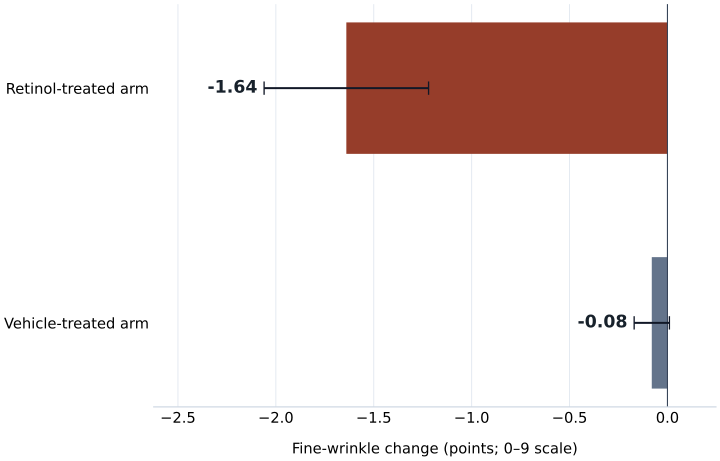
Paired arm comparison; whiskers show 95% confidence intervals.
Score changes are not percentages; intervals describe arm means.
Download the source-labeled chart (PNG) · Download the data (CSV) · Download the chart (SVG)
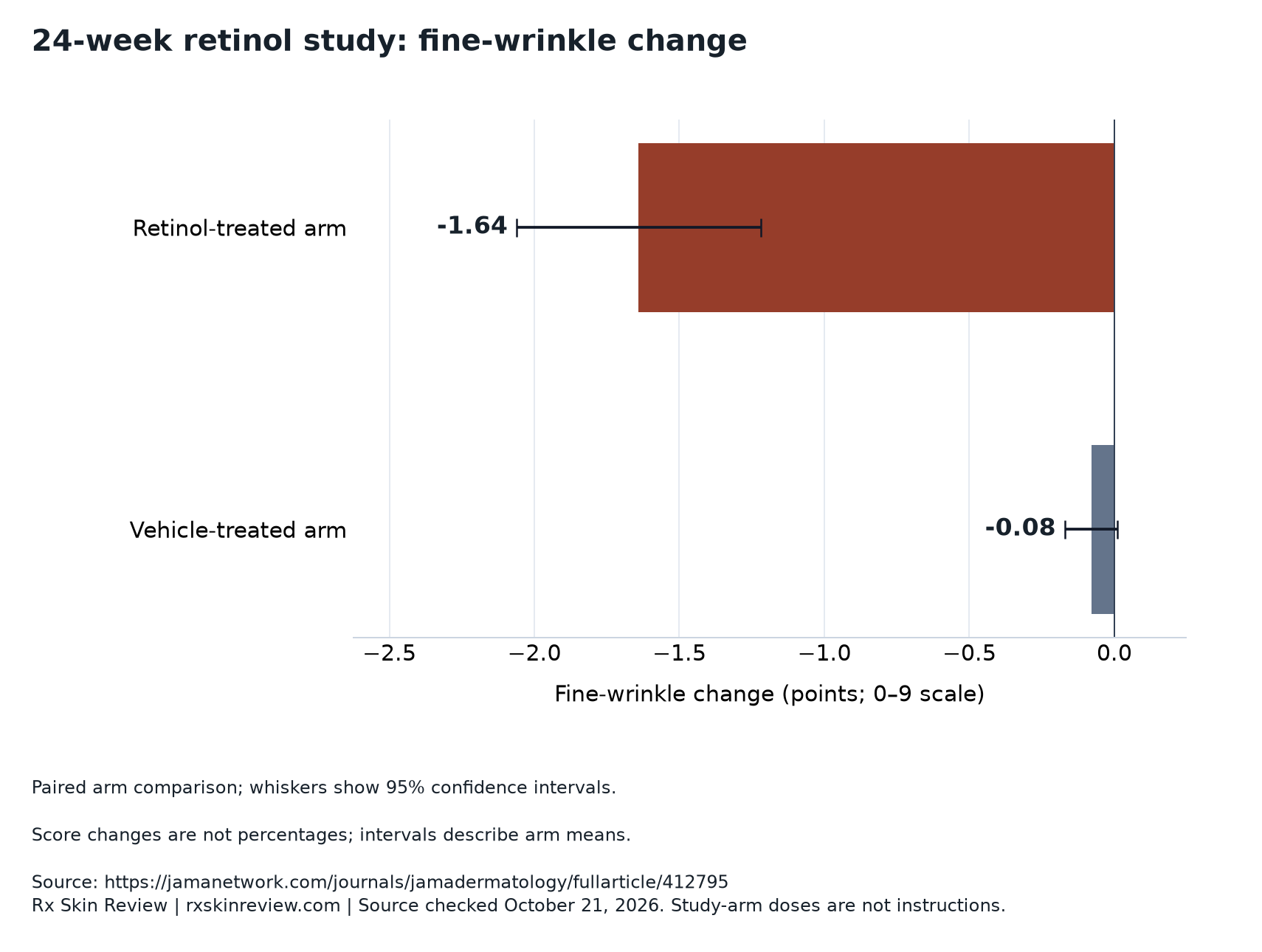
| Study group | Reported value | 95% confidence interval |
|---|---|---|
| Retinol-treated arm | -1.64 | -2.06 to -1.22 |
| Vehicle-treated arm | -0.08 | -0.17 to 0.01 |
Sections in this article
Define the comparison before judging the claim
A controlled comparison needs a precise question. The active preparation and its vehicle form a contrast: the vehicle is the comparison preparation without the active ingredient under investigation. That contrast differs from comparing a purchase with doing nothing, comparing two businesses, or asking whether a whole skincare routine feels worthwhile. Each question has a different alternative against which success must be judged.
Consider a hypothetical reviewer who gives a consultation service a high score for clear cancellation terms. That judgment could be sound while saying nothing about biological efficacy. Conversely, a carefully measured biological effect would not establish that the service answers messages promptly. This is an editorial distinction between kinds of evidence, not a criticism of either kind. A credible review should identify the question each document answers before combining conclusions.
Our review methodology is a useful place to begin that separation. For a scientific claim, write down the treatment, comparator, outcome and setting in a single sentence. For a commercial claim, write down the specific term being evaluated and the document that supports it. If the two sentences require different evidence, one citation should not silently do both jobs.
A paired experiment changes the unit of reasoning
When the same person contributes treated and comparison sites, the central observation is a within-person difference. Age and many other personal characteristics are shared across the two sites. This design can reduce some sources of variation, but it does not turn two sites into two independent people. Counting every site as a separate participant would give a misleading impression of how much independent information the experiment contains.
Random allocation and blinded assessment address different problems. Allocation concerns how a treatment is assigned; blinding concerns what an observer knows while making a measurement. Neither should be used as shorthand for the other. Even a well-designed comparison needs scrutiny of whether the sites are comparable, whether treatment can affect the other site, and whether visible clues could influence ratings. These are design questions to ask, not evidence that any particular bias occurred.
Generalization is a further step. A reader browsing mature-skin product coverage might reasonably ask whether an experiment fits their question. The useful exercise is to list the characteristics that would have to match, then mark which matches have evidence. A familiar ingredient name cannot answer a population or body-site question by itself. Similarity is a reason to investigate a connection, not a substitute for testing it.
Exposure belongs inside the interpretation
Staff planned up to three applications weekly; actual mean exposure was 1.6 after withholding for irritation.
A treatment schedule can be described in at least three ways: what was planned, what was actually received and what remained possible after tolerability problems. Those descriptions need not coincide. If an analyst discusses only the intended schedule, a reader may incorrectly assume that everyone received an identical exposure throughout. Recording interruptions helps clarify what treatment experience an outcome estimate actually represents.
For an original hypothetical example, imagine a study that permits ten sessions but participants receive between four and ten. A result from that study cannot automatically be called the effect of ten completed sessions. Nor would comparing the people with four sessions against those with ten isolate a dose effect: the reasons for receiving fewer sessions might also relate to their outcomes. A separate comparison would be needed to address that question. This is why a clinical report should not be repurposed as a home-use schedule or a rule that greater exposure necessarily produces greater benefit.
Missing observations remain an analytical problem
Intent-to-treat, abbreviated ITT, describes an approach that aims to retain participants in their assigned comparison. Last observation carried forward, or LOCF, fills a later missing value with that person’s most recent available measurement. Keeping someone in an analysis is therefore different from directly observing their outcome at the final visit. An analysis label cannot make unavailable observations reappear.
A hypothetical participant illustrates the issue. Suppose a score was measured halfway through a study and the final visit was missed. Carrying the earlier score forward treats it as the later value for that calculation. The actual later score might have improved, worsened or stayed similar. The calculation itself does not tell us which possibility occurred. Its usefulness depends on assumptions about the missing outcomes and the reasons they are missing.
Completer analyses answer a different question by restricting the calculation to people with the required follow-up. They may be informative, but agreement with another analysis is not guaranteed, and disagreement would need explanation. A stronger research program would examine plausible alternatives for missing outcomes and report how much conclusions change. For a review reader, the important habit is to ask both who contributed and which entries were observed rather than filled in.
Keep score points, percentages and uncertainty distinct
A numerical rating scale is a measuring rule, not a count of physical wrinkles. In an invented example, a change from six points to four is a two-point reduction. Expressing that arithmetic as one third of the starting score does not establish that one third of visible wrinkles disappeared. To make that physical claim, the measurement would have to count wrinkles or validate a corresponding relationship.
Confidence intervals describe the uncertainty of estimates under statistical assumptions. They do not describe the range containing a specified proportion of individual responses. A standard error is a different statistical quantity: it summarizes the estimated variability of an estimator. Two charts can look similarly precise while using different bars, so their captions and analysis populations matter as much as their shapes.
For paired data, uncertainty about the difference depends on how the two measurements move together within people. Subtracting endpoints of separate intervals does not reconstruct a valid paired interval. Likewise, a small P value is not the size of a benefit or a forecast for an individual. Readers moving from fine-line coverage to a scientific chart should keep the scale, estimate and uncertainty in separate mental boxes before deciding how much practical importance to attach to a result.
| Quantity | Question it addresses | Common substitution to avoid |
|---|---|---|
| Score change | How far a rating moved on its defined scale | Percentage of visible wrinkles removed |
| Confidence interval | How uncertain an estimated quantity is under the analysis assumptions | A range of individual responses |
| Standard error | How variable an estimator is estimated to be | A confidence interval with an unstated multiplier |
| P value | How compatible the data are with a specified null model | Magnitude or personal probability of benefit |
A laboratory signal needs a separate causal argument
Only significant biopsy findings were reported: glycosaminoglycans, n=6, and procollagen I, n=4. Injury and ulcer protection were hypotheses, not measured endpoints.
A biomarker is a measured biological characteristic. It can help investigate a mechanism without being the clinical outcome a reader cares about. Seeing a laboratory measure and an appearance score change does not, by itself, establish that the first change caused the second. Both could respond to treatment through different pathways. Establishing mediation requires a design and analysis that can investigate the proposed chain, not merely two favorable observations.
Selective reporting matters because readers need to know the set of questions asked, not only the answers that crossed a statistical threshold. Imagine an illustrative experiment testing several laboratory measures and publishing only the most striking result. The published result might deserve follow-up, but evaluating its reliability would require knowing how the tests were selected and handled. For clinical translation, the next question is whether a proposed mechanism predicts a meaningful patient outcome in an appropriate study. Biological plausibility can justify that next experiment; it cannot stand in for its result.
Tolerability affects both the experience and its measurement
An adverse-event count, a severity rating and a withdrawal count describe different things. The same person can report more than one symptom, so adding symptom categories may count people repeatedly. A percentage additionally requires an explicit denominator and a time window. If either is unclear, presenting an apparently precise percentage can create information that the report does not actually provide.
Symptoms can also affect interpretation beyond their immediate burden. If a visible reaction reveals which site received a treatment, an observer’s expectations could become relevant. If discomfort changes exposure, the treatment experience changes too. These possibilities should be distinguished from demonstrated bias. A careful reading asks how the study monitored them and how an alternative design could reduce uncertainty.
For a hypothetical future trial, the protocol might specify symptom collection at every visit, report the number assessed at each visit, and distinguish stopping treatment from leaving follow-up entirely. Continuing outcome collection after treatment stops can answer a different question from analyzing treatment completers alone. A consumer review should therefore resist compressing tolerability into a single adjective. Frequency, severity, consequences and the completeness of observation deserve separate attention, alongside any measured benefit.
Related tretinoin studies provide context, not a conversion chart
The 1995 abstract describes 99 completers in a 48-week comparison of 0.1% and 0.025% tretinoin creams with vehicle; the higher strength caused more erythema and scaling. The 2005 abstract describes 204 participants in a two-year randomized comparison of 0.05% tretinoin emollient cream with vehicle for facial photodamage. These are different investigations, not extra arms of one experiment.
An indirect comparison has to account for more than the active ingredient. Follow-up, baseline severity, outcome definitions, anatomical site, treatment management and who remains under observation can all change the question. A larger-looking number from one report cannot rank preparations unless the numbers measure comparable outcomes under a defensible comparison. Sharing a drug family does not supply that missing design.
The companion analysis of tretinoin concentration and irritation develops the difference between a nonsignificant contrast and demonstrated equivalence. A future head-to-head study would need to choose its comparison, endpoint and analysis before interpreting a ranking. That is a more informative research question than calculating a concentration conversion from unrelated reports. Percentages printed on preparations identify concentrations; they do not establish interchangeable biological effects or comparable personal treatment plans.
| Evidence type | Document to examine | Separate question to keep open |
|---|---|---|
| Controlled skin experiment | Treatment, comparator and outcome definitions | Would the same contrast apply in the intended setting? |
| 1995 concentration report | Indexed primary abstract | Does the reported comparison justify an equivalence claim? |
| 2005 longer-duration report | Indexed primary abstract | How does the analysis handle follow-up and uncertainty? |
| Current product labeling | Exact formulation’s official label | Does the proposed use match this product and its limitations? |
Disclosures and labeling answer different kinds of questions
Four authors disclosed conditional patent royalties; that establishes neither study funding nor payments received. Financial interests deserve attention because they help readers evaluate incentives, but a disclosure is not itself a result or a verdict on a result. The appropriate response is to inspect the methods, reporting choices and opportunities for independent replication with that relationship in view.
The current RENOVA 0.02% label concerns adjunctive mitigation of fine facial wrinkles with comprehensive skincare and sunlight avoidance. It does not claim wrinkle elimination or repair of sun-damaged skin. Safety and effectiveness beyond 52 weeks or above age 71 are not established; pregnancy or attempted pregnancy precludes use under the label. These statements belong to that exact tretinoin cream, not to retail retinol as a category.
A research article and a product label therefore have complementary roles. One explains a particular investigation; the other communicates the authorized product’s indications, precautions and limitations. A result from a separate formulation cannot silently rewrite a label. Nor can an ingredient-family resemblance resolve personal suitability. Those questions require the actual product information and an appropriate clinical assessment, rather than a reconstructed regimen from an experiment.
Build a review with a traceable chain of evidence
An editorial review should let readers follow each claim to the right kind of document. The source register helps organize that work. For a biological claim, the chain should identify the investigation and the precise endpoint. For a contract claim, it should identify the current terms. A broken link in either chain is a reason to narrow the statement, even when the overall story sounds plausible.
For example, the Curology Custom Formula Rx review and Dermatica review are places to inspect documentary terms. Those links do not identify either service as a participant in the research or establish outcomes for its preparations. This is our editorial interpretation: procurement questions and clinical-effect questions should remain separately auditable, so a reader can see which uncertainty each page actually reduces.
A useful final exercise is to rewrite a broad promise as a testable sentence. Replace “rejuvenates skin” with a specified outcome, population, comparison and time frame. Then ask whether the cited evidence measures that sentence. If several substitutions are needed to make the promise fit, describe those substitutions openly. The goal is a review that preserves the scientific result’s identity while making its relevance, and the remaining research questions, understandable.
Questions about the evidence
Does a good service review establish clinical effectiveness?
No. A review of access, communication or contract terms can be useful on its own terms, but a biological claim requires clinical evidence suited to that claim. The editorial task is to keep those judgments traceable to separate documents. A positive assessment of one does not supply missing evidence for the other.
Why should a reader care whether a chart uses confidence intervals or standard errors?
The bars describe different quantities. A confidence interval is an interval estimate constructed under specified statistical assumptions; a standard error estimates variability of an estimator. Their appearance alone does not make them interchangeable. Before comparing charts, check the caption, the population analyzed and the outcome scale. Otherwise, a visual comparison may combine unlike analyses.
Can a small biopsy analysis explain a visible change conclusively?
A plausible explanation needs more than association. A mechanism claim asks whether a biological pathway actually accounts for an outcome, which calls for evidence about the causal chain. Laboratory measurements can help develop that question. They should not be promoted into proof of an unmeasured clinical benefit merely because the explanation sounds biologically coherent.
Why does a published concentration not translate into a personal regimen?
Concentration is only one component of an intervention. A personal decision also concerns the exact preparation, indication, relevant precautions and clinical circumstances. Dividing one printed percentage by another cannot resolve those questions. Research exposure details help identify an experiment; they do not replace product-specific instructions or an assessment by the clinician responsible for treatment.
What would make a retail claim more convincingly supported?
Evidence would need to fit the actual claim: a relevant preparation, appropriate participants, a meaningful outcome, a suitable comparator and transparent follow-up. Independent replication and complete reporting would make the chain easier to assess. A useful claim should also disclose the uncertainty that remains, rather than treating the existence of a citation as a substitute for checking its relevance.
Editorial assessment
The most useful conclusion for a review reader is a disciplined way of connecting evidence to a question. Start with the actual comparison, preserve the measurement units, identify missing-data assumptions and distinguish proposed mechanisms from clinical outcomes. Then examine whether the product or service claim asks the same question. That process can recognize informative research without extending it into a promise the experiment was never designed to test. It also directs future work toward a concrete gap: which additional comparison, observation or follow-up would make the proposed claim answerable?
Research access and limitations
This analysis uses the full publisher retinol article, including its clinical table footnote and financial disclosure; the indexed primary abstracts of the 1995 and 2005 tretinoin reports; and the current official RENOVA label. Supplements, individual participant data and the trial registry were not independently assessed. Methodological examples are illustrative, not additional participants or outcomes. This is educational analysis, not individualized treatment advice.
Sources and access notes
Sources checked October 21, 2026. The access notes below identify the material examined for this article.
- Improvement of naturally aged skin with vitamin A (retinol).
Full publisher research article, including original clinical table-image footnote, figure captions, Comment and Financial Disclosure; no supplements or individual data reviewed. · Checked October 21, 2026
- DailyMed - RENOVA- tretinoin cream
Official current labeling retrieved in full · Checked October 21, 2026
- Two concentrations of topical tretinoin (retinoic acid) cause similar improvement of photoaging but different degrees of irritation. A double-blind, vehicle-controlled comparison of 0.1% and 0.025% tretinoin creams.
Indexed original research abstract · Checked October 21, 2026
- Long-term efficacy and safety of tretinoin emollient cream 0.05% in the treatment of photodamaged facial skin: a two-year, randomized, placebo-controlled trial.
Indexed original research abstract · Checked October 21, 2026